
This blog post is a continuation of the previous post and highlights our 2 day visit to Merida!

Sunday morning dawned beautifully sunny and hot! After a nice breakfast at the Cafe POP on Calle 57 x 60 y 62 (shorthand for located on 57th Street between 60th and 62nd), we started our walk to the Paseo de Montejo. First stop, of course, were the vendors in the Santa Lucia park!

A few blocks away, we entered the Paseo de Montejo from the southern end. Information from a Merida website…
“As a result of the henequen boom the region enjoyed toward the end of the XIXth century, a group of Yucatecan landowners decided to implement a project to build a public promenade that would update the capital and be “worhy of the City of Mérida”. Paseo de Montejo got its name from the founder of the city, Francisco de Montejo y León “El Mozo”. It was built between 1886 and 1905 and was inspired on the Champs Elysees in Paris.”

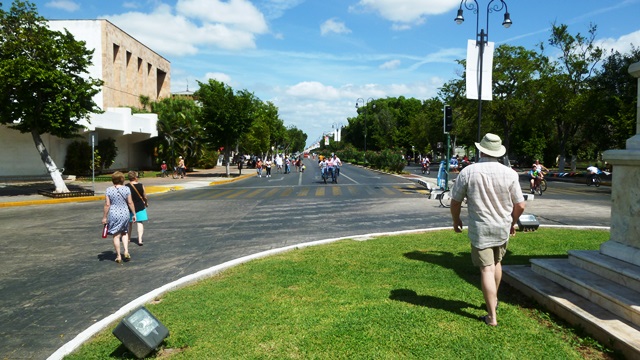
The first memorable buildings on the Paseo de Montejo are the “Casa Gemelas”…
“These small palaces have frenchified architectural elements, visible even on the wrought iron balconies and entrance doors, which are of the few specific reminiscences left over from the period of splendor Yucatán enjoyed during the first decade of the XXth century.”


Many of the era’s mansions now house banks and other businesses.

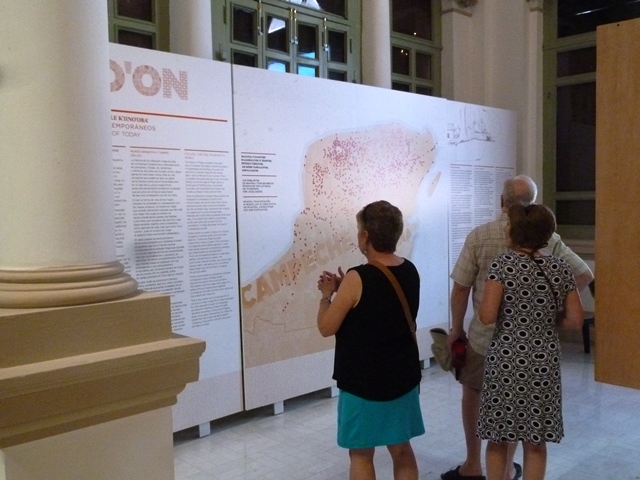
Our next stop was the “Museo Regional de Antropología e Historia” which is housed in the Palacio Cantón.
“This mansion, a fine example of the mannerist baroquization trend in architecture, is probably the building with the highest hierarchy on Paseo de Montejo. This is not only true because of its structural attention to detail but also due to the fact that since 1966 it serves for the promotion and diffusion of archaeological and cultural knowledge of the Mayan generations of yesterday, today and tomorrow.”


As the museum was open to the public that day, we decided to take a memorable tour!




Just across the Paseo was another Maya heritage building…

In the centre of the next ‘glorieta’ (roundabout) is the Monumento Felipe Carrillo Puerto…
“…in honour of the Mexican journalist, politician and revolutionary who became known for his efforts at reconciliation between the Yucatec Maya and the Mexican government after the Caste War. He was governor of the Mexican state of Yucatán from 1922 to 1924.”

A short distance up the Paseo is one of my favourite buildings, Casa Peón del Minarete, which “…is typical XIXth century neoclassical architecture. It has a tall windowed belvedere of Moorish influence and is one of those few big houses that have withstood the deterioration of urban beauty this avenue once possessed.”


Unfortunately, the heat of the day was upon us so we weren’t able to complete the walk up the Paseo to the “Monumento a la Patria”.
“This masterpiece that depicts the story of México stands almost 46 feet tall and is located on the third traffic circle on Paseo de Montejo, in white Mérida. It was the first altar raised to honor nationality, not only in México but in America, and is the only monument in the world erected during the XXth century to have been cut directly on stone.”

Back in Uaymitun the following day, we witnessed an amazing spectacle in the waters just offshore of our beach. Rumoured to be over 1000 small fishing boats started to gather in the waters between Dzilam de Bravo and Rio Lagartos for the annual ‘pepino del mar’ (sea cucumber) harvest. It is a real wild west roundup kind of event as the average fisherman could easily make enough money in about 2 weeks as he could in the rest of the year! Unfortunately, the craziness of the harvest takes many tolls, including 3 deaths by drowning or the bends this year!

That evening, Janine cooked us a delicious Vodka Penne and vegetable stirfry dinner!

To wrap up this blog post, please humour me as I include just a few of my many pics from that night’s sunset!


That’s it for this post… watch this space for our trip to Mayapan!
Cheers!
Love to all,
-doug and elaine